
How I Built a Spy-Themed German Conversation Class with AI
🕵️♀️
My student is an agent on a mission.
The goal: Find out secret information about Steffi Graf. Armed with just two words, she has very little to go on.
Her informant is “The Quizmaster”, a shadowy figure reluctant to give up precious information.
She guesses, asks, coaxes. The Quizmaster refuses.
“I only answer questions you ask me in German.”
“You’re close. Ask me more specifically.”
The student has studied German in the past, but not spoken for a while. She’s challenging herself, asking new questions, putting together sentences.
Will she convince The Quizmaster to give up the information she needs?
Only if she digs in and does exactly what she signed herself up for: practice her German conversation skills!
This thrilling scenario is not an episode of the latest Netflix crime drama, but part of a whole world I built recently. Not for a novel or a TV show, but for a German course.
It became my way of exploring AI lesson planning for language teachers without losing the playful, human parts of teaching.
Where does a human language teacher fit in 2026?
You see, sometimes it can be hard to be a language teacher.
People think you’re just around to correct them while they discuss the weather. And explaining grammar is fun, but many students switch off when you try.
Plus, look. I know AI has entered the building. Duolingo gives you streaks. ChatGPT gives you conversation practice.
Where does a human teacher fit in 2026?
Maybe, like me, you’re feeling that the world is asking you to prove yourself yet again just so you can keep your work.
This year, I decided to offer a new German course. It’s my first in 9 years. In between, I created AI Language Club and led in-country retreats.
Really? Does anyone join these anymore?
I wasn’t sure if I’m still relevant as a teacher. I don’t even have a TikTok account!
Building a game world with AI instead of “just another course”
So I tried an experiment: Use what I know about AI, tell the story, and let people join if they want to.
And surprisingly, once I started I found inspiration everywhere with just one change:
Instead of a course, I decided to build a game world.
Meet Operation Konversation, my spy-themed conversation class.
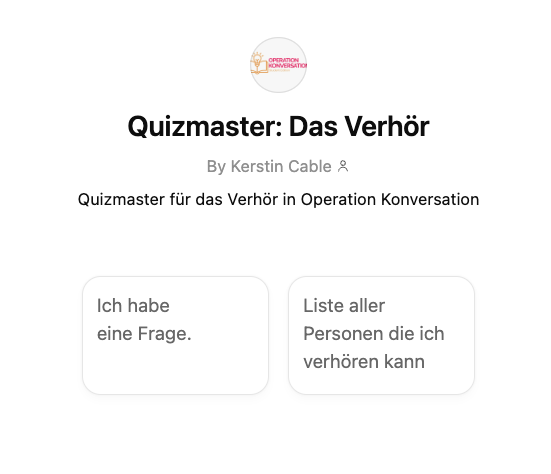
Screenshot of the AI Quizmaster I created for Operation Konversation
Gamification in language teaching does not have to be complicated
Students became Konversation Agents. New lessons are weekly missions. Just like James Bond, the students interrogate and fulfil tasks, with secret recordings they can drop over to me for feedback.
This German course is not a sad last hurrah — it’s actually one of my best!
I’m seeing real results and the student feedback has been a win. One of them says it’s the most creative class she’s ever joined. And I don’t know if she noticed, but I can tell her German skills are doing exactly what they should too.
This could be the language class of the future
The language class of the future is NOT going to be all tech.
And it won’t be all classroom either.
If you want to be the teacher of the future, embrace the quirkiest, most valuable parts of your human imagination.
What if your class was a detective agency? A nature expedition? A time travel mission? A cooking show in a foreign language?
In your next language class, it’s your time to focus on the fun, creative parts of teaching.
To help you with this, I put together a 30-minute training called AI for A+ Lesson Planning. Plus, there’s a lesson creator in the training to help you build your first AI enhancement yourself.
This concludes today’s agent briefing.