
The Hidden Hours Behind Every Great Lesson

Here is a question worth asking: what actually happens in a 60-minute language lesson?
The answer depends on who you ask. A learner might say: we practised past tense, did a speaking activity, and reviewed vocabulary from last week.
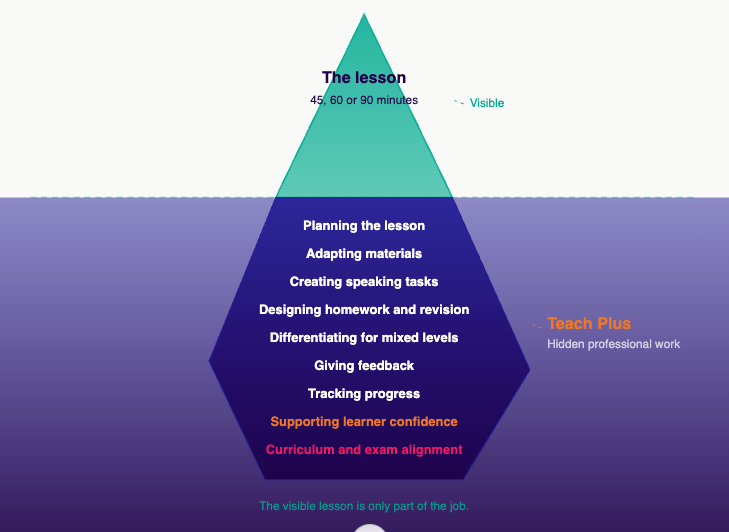
But if you ask the teacher, they’ll tell you it never takes just an hour. In reality, teachers invest significant care and attention behind the scenes, so that students get exactly what they came for, at the right time, and in the promised format.
Schools budget for teaching hours. They do not budget for the 5–10 hidden hours required to make those lessons actually work.
The Invisible Workload Behind Great Teaching
Teach Plus is all the professional work that wraps around the visible lesson hour and makes it work.
It includes:
Planning lessons and homework:
Deciding what to cover, and sequencing it so the lesson flows well.
Connecting the lesson content to worksheets and exercises, and choosing appropriate working volumes.
Writing engaging, level-appropriate, and achievable prompts for every lesson.
Choosing or adapting materials : Adjusting vocabulary and examples because off-the-shelf resources rarely fit perfectly and levels within groups vary.
Giving feedback :
Providing detailed and actionable evaluations, not just "good job" or “try harder”.
Logging what to revisit, what to accelerate, what to drop.
Supporting learner confidence : Providing psychological support and motivation to lower the barrier to progress in language learning.
Checking curriculum or exam alignment : especially important in corporate training, CELTA programmes, and exam preparation contexts
Teach Plus is a summary of all these activities, which emphasize the true extent and value of a great teacher’s service.
The Best AI Uses in Education Are Unseen By Students
“AI doesn’t replace teachers. It replaces unpaid prep work.”
AI tools can save time and energy for teachers doing Teach Plus work, for example these tasks:
Adapting one activity for different language levels through the transformer aspects of large language models like ChatGPT, Gemini, Copilot or Claude
Building quizzes, review tasks, Cloze texts: All the core parts of a workbook or worksheet that eat up time and attract small errors when teachers get tired
Drafting correction feedback for written work or even transcripts of student speaking tasks
Evaluating common errors so the lesson content can be adapted more closely to what students need
Writing learner-friendly grammar explanations so students can hear complicated explanations from another angle
AI is also a valuable homework alternative: students can be instructed to try specific prompts, interact with AI, get instant feedback and bring their results to class.
If you want to see what AI-assisted lesson planning looks like in practice, this spy-mission language lesson case study breaks down the actual workflow, prompts, and classroom adaptation process.
Get the full walkthrough training in my AI for A+ Lesson Planning workshop, along with detailed teacher-facing workflow examples.
What Happens When Schools Ignore Invisible Work
If you are a head of department, a director of studies, or someone making decisions about how AI gets implemented across a language programme, this section is for you.
Most schools introducing AI have no implementation strategy whatsoever. ‘Use ChatGPT’ is not a workflow.
If you’re excited to get AI support for the Teach Plus aspects and make your institution’s life easier and possibly cheaper, get staff into a room and discuss the following five points:
Find out where teacher time actually goes. Talk to your teachers. Where does planning time disappear? What tasks take longest? That is where AI support will make the most difference.
Provide training based on real teaching tasks, not generic AI literacy sessions that have nothing to do with lesson planning or EFL or adult education.
Create shared workflows and templates, so teachers are not each reinventing their own approach from scratch every week.
Give teachers time to test, reflect, and adapt. That process is professional work too. It should not happen in unpaid hours.
Agree quality standards for AI-assisted materials, so teacher judgement stays at the centre of what gets used with learners.
The question is not "should we use AI?" The question is: "Where in the teaching process will AI make the most difference, and how do we support teachers in using it well?"
There’s really no point in adding AI on top of a workflow that needs redesigning instead.
I’ve also written about several practical ways language teachers are already using AI tools for lesson planning, speaking activities, and classroom support.
Why Lesson Planning Is the Smartest Place to Start With AI
If “Teach Plus” is where teacher time disappears, lesson and course planning is the most practical entry point for AI support.
That is why I created AI for A+ Lesson Planning as a practical, pre-recorded workshop. It outlines a new approach to letting AI tools carry the load without sacrificing the best parts of the job. Teachers leave the workshop with a complete AI-assisted lesson planning workflow they can immediately test in class.
The Future of Teaching Should Feel More Human
If the invisible workload behind teaching continues to be ignored, everyone pays for it: teachers, students, families, and the institutions trying to keep the whole system running.
AI gives us an opportunity to rethink teaching workflows from the ground up instead of continuing to pile new expectations onto exhausted people. Plus, the conversation about AI in language education becomes much bigger once we stop talking only about tools and start talking about people.
The goal is not to replace teachers, but to give them more capacity to create learning environments where students feel safe, motivated, and supported.