
How Language Teachers Can Start a Podcast (And Choose the Right Format)
Language teachers benefit enormously from podcasting. Starting your own show lets you reach your perfect students and sell them on your personality before they have even booked a lesson.
As I found when I was running my own podcast, the Fluent Show, you do not have to "teach for free" in order to attract an audience of people who really want to work with you. My podcast listeners became regular students, clients, and retreat attendees.
A lot of teachers are scared of putting their voice out there. That is fair. But if you can explain something clearly to a student, you already have the skill. Here is where to start:
Start With the Listener
The best podcast formats are built around the person listening, not the person recording.
Who is this show for? A language teacher wanting professional development? A beginner trying to learn Spanish? A small business owner who commutes?
Where will they listen? Driving, walking, cooking, or sitting at a desk with full attention? The answer affects how complex your content can be.
How much attention do they have? Some listeners want something they can action after 10 minutes. Others want to sit down and really think.
What do they actually want? Quick tips, thoughtful conversation, interviews with interesting people, company, entertainment, or step-by-step tips?
What would bring them back? This is the question most new podcasters skip. A format that keeps listeners returning is worth more than a format that impresses them once.
There is no universally correct answer to any of these, and often it is most successful to create a mix of several format ideas. It's also helpful to see what's already out there and analyze the types of shows that are popular on platforms like Spotify.
Here’s the next point to consider.
The Main Podcast Formats
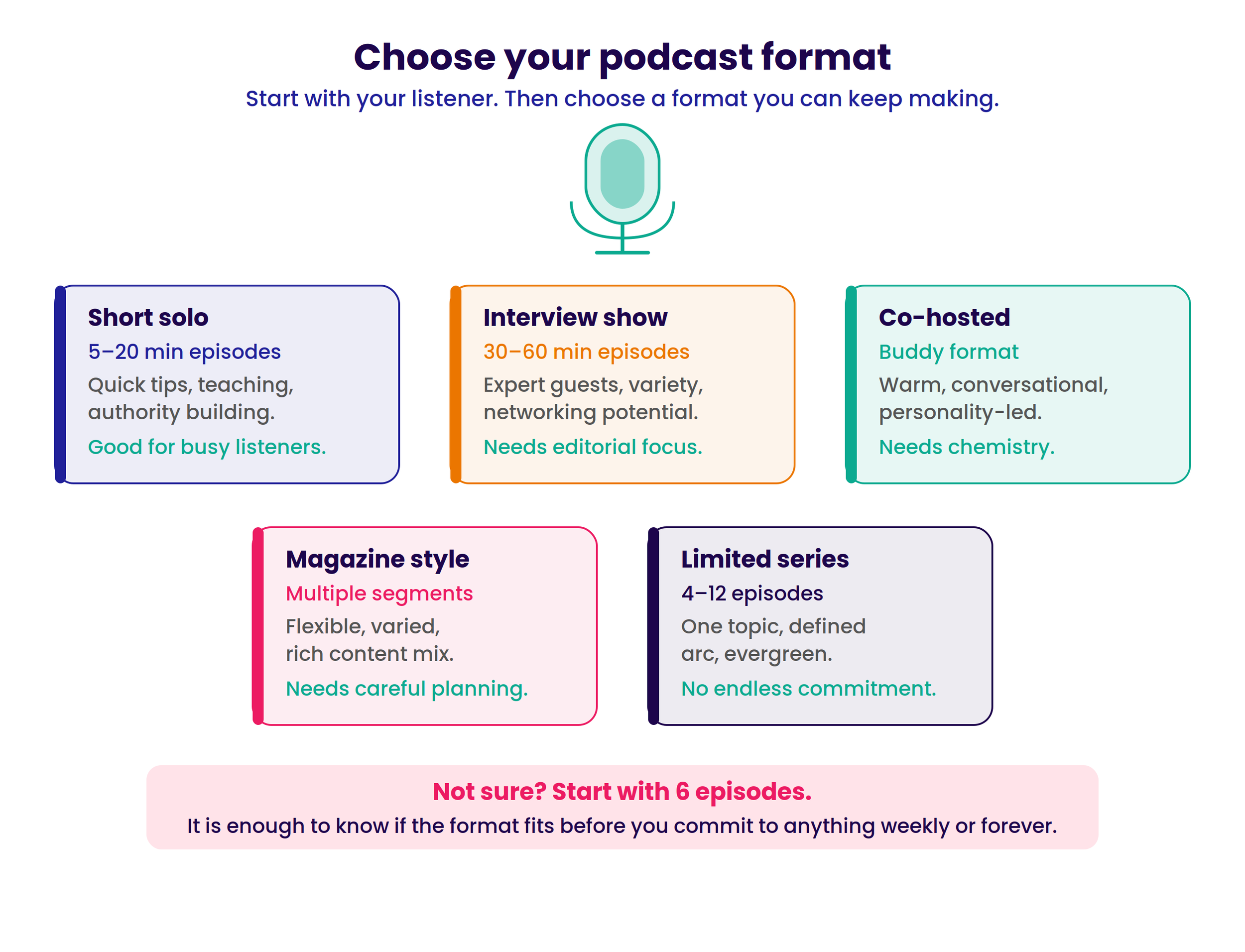
Here are the five formats worth considering, with an honest look at what each one involves.
Format 1: Short Solo Episodes
These are focused, scripted or semi-scripted episodes like this one sharing tips for teachers, typically between 5 and 20 minutes, where the host speaks directly to the listener.
Good for teachers, educators, course creators, language coaches, and anyone who wants to establish clear authority on a specific topic. Also excellent for listeners who are busy, commuting, or want quick and actionable content.
Pros: Focused and easy to search. Good for batching. New listeners can try an episode with minimal time investment. Strong for SEO-style topics where people are looking for specific answers.
Challenges: Requires confidence speaking alone and a clear structure for every episode. It can feel pressured if you expect every episode to be perfectly polished. It can get boring for loyal listeners.
Format 2: Interview Shows
The interview show is focused on featuring a guest every week, and the show host is a stand-in for the listener in getting as much information from the host as possible. Interview shows are fascinating stuff and a great host can make every show delightful and interesting.
Here are some of my favourite interviews I hosted:
David Peterson, creator of fictional languages for Hollywood and beyond including the languages in Game of Thrones
Scott Young, bestselling author of “Ultralearning”
Sarah F Phillips, neuroscientist and linguist who studies bilingualism, code switching, and our language brains
Pros: Guests bring energy and credibility. Strong networking potential. You do not need to know everything yourself. A good conversation can be genuinely surprising.
Challenges: Scheduling guests takes time. Guest quality varies. Editing can be longer and more unpredictable.
And finally, hosting interviews means being a good guide for your guest. Without a clear editorial point of view, the show becomes "interesting person talks about interesting thing" with no strong reason for listeners to return.
If the interview format appeals to you, Inspiring Interviews is a course designed to help you become the kind of host whose guests give their best.
Format 3: Co-Hosted or Buddy Shows
Two hosts, a shared chemistry, a recurring conversation. Here’s how these types of shows sound: Fluent Show, If Books Could Kill.
Good for personality-led content, commentary, education with entertainment, and audiences who enjoy the dynamic between two people more than any single topic.
Pros: More natural energy than solo shows. Easier to create warmth. Listeners feel part of an ongoing relationship. The workload and creative energy are shared.
Challenges: This format depends entirely on chemistry and commitment from both people. Scheduling two people is harder than scheduling one. Decisions about direction, content, and priorities need to be made together. If the co-host relationship breaks down, the show usually does too.
Format 4: Semi-Structured or Magazine-Style Shows
A single episode contains multiple segments: perhaps a short teaching section, a listener question, a resource recommendation, and a guest interview. The structure repeats across episodes, but the content varies.
Good for creators with range, educators who cover multiple topics, or anyone who wants to build a show that feels like a publication rather than a single-topic channel.
Pros: Flexible and varied. Can feel rich and interesting. Works well for a one-person show.
Challenges: Without a repeatable structure, it can become messy. This format rewards careful planning more than any other.
Format 5: Limited Series
A defined run of episodes arund a single theme, project, or arc. A beginning, a middle, and an end. Serial pioneered this.
Good for course creators, educators launching something specific, authors, or anyone who wants to explore one topic in depth without signing up to produce forever.
Pros: Contained, plannable, and easier to promote as a complete thing. Less pressure than an open-ended show. Works well as evergreen content once the series is done.
Challenges: Needs a clear arc and a reason for the structure. Harder to build a regular listening habit because there is no ongoing show to return to. Requires promotion before, during, and after release.
How to Choose
If you are not sure which format is right, run through these questions:
Do I want to speak alone, or with someone else?
Do I have the time and energy to schedule and prepare guests?
Do I want my show to teach, explore, entertain, or build relationships — or some combination?
Can I repeat this format across 10 episodes without regretting my choices?
What kind of show would I genuinely enjoy making?
What is realistic with my current time, energy and commitments?
If you are still unsure, just pick one format you’ll enjoy for a limited run of six episodes before committing to an eternal show. Six episodes is enough to learn how the format feels to make, whether listeners respond, and whether you actually enjoy it. After that, you can adjust.
A Short Case Study: What I Learned From the Fluent Show

I started podcasting because I loved listening to podcasts. I was spending hours a week with my favourite shows, and starting my own felt like a natural next step rather than a strategic decision.
My podcast launched as an interview show. I was curious about my guests, which made a real difference to the quality of the conversations.
Over time, the show evolved into a co-hosted format with my friend Lindsay, which suited our combined energy and the audience we had built.
I evolved it into a hybrid format where I followed this pattern: solo show, Lindsay show, solo show, interview. That version of the show ran until it had accumulated over two million downloads.
It is no longer making new episodes, and that feels right. A podcast does not have to run forever to have been worth making.
The lesson I took from the whole experience: choose a format that serves your listener, but also choose one you can honestly keep showing up for. A format that suits your energy and your life will outlast any format that looks impressive on paper but exhausts you by episode four.
Before You Start Recording
If you want to map out your format, your audience, your episode structure and your first few ideas before you commit to any of it, the Podcast Success Blueprint course on Udemy and the Podcasting 101 Planning Workbook are both designed to help with exactly this stage.
The goal is to start with a clear idea of what you are making and who it is for, so that when you do press record, you already know what kind of show you are building.